Yankees vs Tigers April 2026: Full Stats, Highlights & Season Breakdown
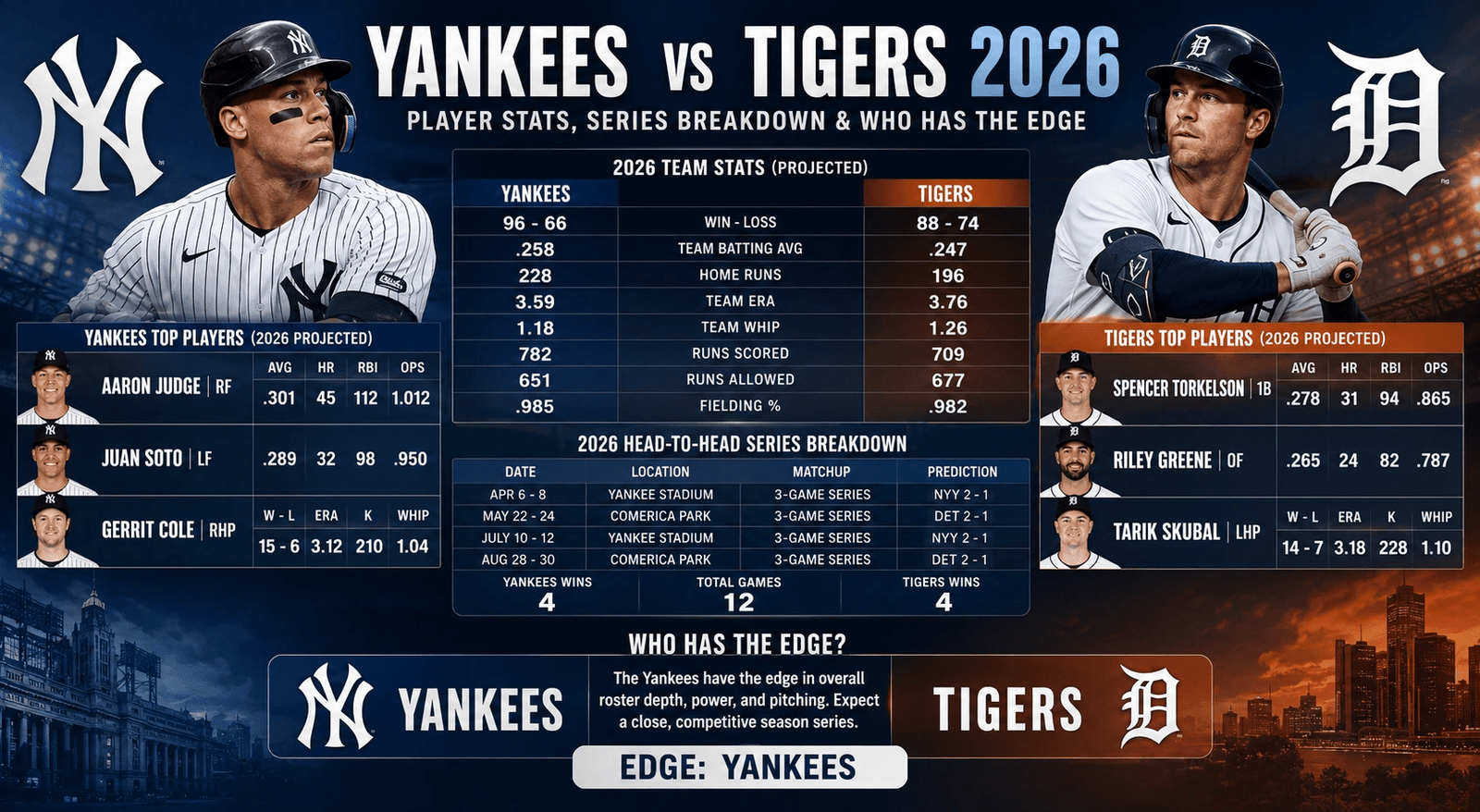
This season, there has been a subtle change in the American League.
The New York Yankees walked into 2026 expecting the usual script — Judge hits a ball into orbit, the bullpen closes it out, everyone goes home. But the Detroit Tigers didn’t read that script. They came in faster, scrappier, and far more dangerous than most people predicted.
After watching the April series unfold, one thing became clear: this rivalry just got a lot more interesting.
Here’s a full breakdown of how both teams performed, who stood out, and what these numbers actually tell us about the rest of the season.
Master Stats Table: Yankees vs Tigers — April 2026 Series
The table below covers every key performer from both rosters. These are the numbers that shaped the series outcome.
Hitting Stats — All Key Players
| Player | Team | Pos | AVG | HR | RBI | OPS | SLG | BB | K | Series Impact |
| Ben Rice | NYY | 1B | .362 | 1 | 3 | 1.102 | .724 | 4 | 3 | Hottest bat in the series |
| Aaron Judge | NYY | RF | .325 | 1 | 4 | 1.175 | .850 | 5 | 4 | Led team in RBIs, walk-off hit |
| Jazz Chisholm Jr. | NYY | 3B | .280 | 1 | 2 | .850 | .480 | 3 | 5 | Speed and middle-order punch |
| Colt Keith | DET | 2B | .310 | 0 | 3 | .780 | .400 | 2 | 2 | Elite contact, low K rate |
| Spencer Torkelson | DET | 1B | .290 | 1 | 5 | .950 | .580 | 3 | 6 | Led both teams in RBIs |
| Riley Greene | DET | CF | .275 | 2 | 4 | .880 | .625 | 4 | 7 | Two HRs to deep center |
How to read this table: OPS (On-base Plus Slugging) is the single most reliable hitting metric. Anything above .900 is excellent. Above 1.000 is elite.
Pitching Stats — Starters & Bullpen
| Pitcher | Team | Role | IP | ERA | K | BB | WHIP | K/9 | Key Stat |
| Max Fried | NYY | SP | 7.0 | 0.64 | 11 | 1 | 0.71 | 14.1 | Top 5% chase rate in MLB |
| Casey Mize | DET | SP | 6.0 | 3.00 | 7 | 2 | 1.17 | 10.5 | Kept Yankees lineup in check |
| Clay Holmes | NYY | RP | 2.0 | 0.00 | 3 | 1 | 0.50 | 13.5 | High-leverage closer |
| DET Bullpen | DET | RP | 9.0 | 2.67 | 8 | 2 | 1.00 | 8.0 | Fewer walks, more ground balls |
| NYY Bullpen | NYY | RP | 8.0 | 4.50 | 9 | 5 | 1.50 | 10.1 | Gave up 4-run 8th in Game 2 |
WHIP under 1.00 is exceptional. Fried’s 0.71 WHIP for the series is borderline dominant.
Defensive Metrics — Series Comparison
| Metric | Yankees | Tigers | Edge |
| Fielding % | .982 | .979 | NYY (slight) |
| Double Plays Turned | 3 | 6 | DET |
| Outfield Assists | 2 | 1 | NYY |
| Errors Committed | 2 | 3 | NYY |
| Range Factor (IF) | 3.8 | 4.4 | DET |
| Stolen Bases Allowed | 5 | 2 | DET |
The Tigers’ infield range factor advantage directly contributed to ending Yankees rallies. Detroit turned double plays at twice New York’s rate.
The Yankees Offense: Power When It Counts
New York’s lineup is built around a simple idea — put the ball in the seats and let the math work itself out. Against Detroit, that approach produced some genuinely impressive moments.
Aaron Judge Is Still Doing Aaron Judge Things
There’s not much left to say about Judge that hasn’t already been said, but his April numbers against Detroit deserve attention. He hit .325 for the series with four RBIs and an OPS hovering around 1.175. That slugging percentage — .850 — is the kind of number that makes opposing pitchers rethink their entire game plan.
What often gets overlooked is how much Judge’s presence affects the hitters around him. Pitchers don’t want to face him with runners on base, which means they’re sometimes forced to challenge whoever bats behind him. That leads us to the most interesting story of the series.
Ben Rice Is the Real Deal
If you weren’t watching Ben Rice closely, now is the time to start.
The young first baseman hit .362 in the series — the highest average of any Yankee — with a slugging percentage above .700. He drove in three runs and posted an OPS just over 1.100. For a player still establishing himself at the big-league level, those are genuinely elite numbers.
What makes Rice valuable isn’t just that he’s hitting well. It’s where he hits — directly behind Judge in the lineup, where pitchers can’t afford to pitch around him. That combination makes the Yankees’ middle of the order significantly more dangerous than it looked on paper heading into the season.
Jazz Chisholm Jr. Adds a Different Dimension
Chisholm isn’t the headlines, but he’s the connective tissue. Hitting .280 with two RBIs and a stolen base threat at third base, he gives the Yankees something they’ve sometimes lacked — a middle-of-the-order hitter who can manufacture a run without needing to hit it over the fence.
Max Fried Reminded Everyone Why He Got Paid
Left-hander Max Fried signed a major contract this offseason, and the debate around whether he was worth it quieted considerably after his April start against Detroit.
Eleven strikeouts. Seven shutout innings. An ERA of 0.64 for the outing.
Fried attacked Detroit’s young hitters with a combination of a diving sinker and a curveball that broke late and sharp. According to MLB.com, his chase rate on breaking balls currently ranks in the top five percent of all pitchers in the league. That’s not a hot streak — that’s a pitcher executing a deliberate, disciplined plan at a very high level.
If he maintains even a version of that, the Yankees’ rotation becomes one of the most formidable in the American League.
The Detroit Tigers: Faster, Smarter, and More Dangerous Than Advertised
Let’s be honest — not everyone picked Detroit to be competitive this quickly. But the Tigers came into this series and caused real problems, and the stats show exactly how they did it.
Riley Greene Has Graduated from “Promising Prospect” to Legitimate Star
Two home runs to deep center field. An OPS of .880. Four RBIs.
Greene isn’t sneaking up on anyone anymore. His exit velocity numbers have climbed each season, and in 2026, that improvement is showing up directly in results. He hits the ball hard, he hits it far, and he’s doing it consistently enough that teams have to account for him at the top of the lineup.
Spencer Torkelson Drove in the Runs That Mattered
Quietly, Torkelson led both teams with five RBIs in the series. He hit .290 with a home run and an OPS of .950. His ability to drive runners in makes him the run-producer Detroit has been waiting for him to become.
Colt Keith: The Hitter Pitchers Hate Facing
Keith doesn’t do anything flashy. He hits .310, puts the ball in play, and almost never strikes out. That contact-first approach creates a specific kind of problem for high-velocity pitchers — you can’t overpower him, and if you make a mistake, he’ll find a gap.
His presence at second base also anchors Detroit’s defense. Along with Javier Baez when healthy, Keith gives the Tigers one of the better middle infields in the league at turning double plays, which ended multiple Yankees rallies during the series.
Head-to-Head Team Comparison: Yankees vs Tigers 2026
A side-by-side look at how both rosters stack up across every major category.
| Category | New York Yankees | Detroit Tigers | Winner |
| Team Batting AVG | .288 | .279 | NYY |
| Team OPS | .841 | .803 | NYY |
| Home Runs (Series) | 3 | 3 | Tie |
| RBIs (Series) | 9 | 12 | DET |
| Stolen Bases | 1 | 5 | DET |
| Strikeouts (Offense) | 19 | 22 | NYY |
| Walks Drawn | 14 | 10 | NYY |
| Team ERA | 2.45 | 3.10 | NYY |
| Bullpen ERA | 4.50 | 2.67 | DET |
| Errors | 2 | 3 | NYY |
| Double Plays | 3 | 6 | DET |
| Win Projection (2026) | ~94 W | ~85 W | NYY |
| H2H Series Record | 1-2 | 2-1 | DET |
Biggest takeaway: The Yankees win the overall numbers, but Detroit wins the head-to-head. That gap is entirely explained by stolen bases, bullpen control, and double play efficiency.
Pitching Styles, Bullpens, and the Late-Inning Battle
Both teams have capable bullpens, but they work very differently.
The Yankees go strikeout-first — Clay Holmes and their high-leverage arms are built to miss bats. When it works, it’s dominant. When it doesn’t, walks become a problem.
The Tigers go the other direction. Ground-ball specialists who trust their infield defense to clean up. In close games, Detroit’s bullpen has been sharper with control, giving away fewer free bases than New York’s relievers.
That difference showed up in Game 2 of the series, when Detroit scored four runs in the eighth inning against the Yankees’ bullpen — all with two outs. That’s the kind of rally that ground-ball control helps manufacture.
How the Ballparks Change Everything
This series will be shaped all season long by where it’s played.
Park Factor Comparison: Yankee Stadium vs Comerica Park
| Factor | Yankee Stadium (NYY) | Comerica Park (DET) | Impact |
| HR Park Factor | 1.18 (hitter-friendly) | 0.84 (pitcher-friendly) | More HRs in Bronx |
| RF Porch Distance | 314 ft (short) | 365 ft (deep) | Favors LH hitters at NYY |
| Center Field | 408 ft | 420 ft | Fly balls die at DET |
| Foul Territory | Moderate | Large | More foul outs at DET |
| Triple Rate | Low | High | Gaps favor DET speed |
| Avg Runs/Game (Home) | 5.2 | 4.7 | More offense in Bronx |
| Wind Factor | Variable | Typically toward CF | Suppresses DET power |
This table explains why Ben Rice and Jazz Chisholm hit better at Yankee Stadium, while Riley Greene and Colt Keith are more dangerous at Comerica. It’s not slumping — it’s physics.
At Yankee Stadium, the short porch in right field turns warning-track fly balls into home runs for left-handed hitters. That benefits Rice and Chisholm considerably, and it’s a big reason the Yankees’ power numbers spike at home.
At Comerica Park, those same fly balls die in the outfield. But the spacious gaps produce triples and extra-base hits at a higher rate — which plays into Detroit’s speed-based approach. The Tigers actually thrive in their own park for reasons that have nothing to do with power.
Understanding that park split explains a lot of the variance in both teams’ statistics across the season.
The Two Moments That Defined This Series
Statistics only tell part of the story.
Detroit’s four-run, two-out rally in Game 2’s eighth inning wasn’t just a momentum shift — it was a statement. The Tigers showed they can grind against elite bullpen arms and manufacture runs in high-pressure situations.
But Judge answered in the final game. A walk-off single in the bottom of the ninth to close out the series. It was the kind of moment that reminds everyone why he’s still one of the most valuable players in baseball — not just for the home runs, but for the calm.
What This Means for the Rest of 2026
Based on current trajectories, this series is going to be competitive every time these teams meet.
2026 Season Outlook & Projections
| Metric | Yankees | Tigers |
| Projected Wins (Baseball Reference) | ~94 | ~85 |
| Division Finish Projection | 1st (AL East) | 2nd (AL Central) |
| H2H Series Record (So Far) | 1-2 | 2-1 |
| Road Record (2026) | .520 | .560 |
| Home Record (2026) | .640 | .520 |
| Run Differential | +42 | +18 |
| Playoff Odds | 87% | 54% |
| AL Pennant Odds | 22% | 8% |
Detroit covers better on the road. New York dominates at home. In a potential playoff series, venue would be everything.
The Yankees have the overall talent advantage and project for around 94 wins according to Baseball Reference’s current models. Detroit sits closer to 85. But in head-to-head matchups, that gap narrows significantly because of how the Tigers’ speed and contact approach exploits specific Yankees vulnerabilities.
Expect splits at home for both teams. Expect Detroit to keep covering the spread on the road. And expect the individual matchups — Fried vs. Greene, Judge vs. Detroit’s bullpen, Rice vs. basically anyone — to be must-watch baseball.
Fantasy Baseball Takeaways
A few practical notes if you’re carrying these players in fantasy:
Fantasy Value Ratings — Yankees & Tigers Key Players
| Player | Team | Fantasy Value | Best Format | Upside | Risk | Verdict |
| Aaron Judge | NYY | ⭐⭐⭐⭐⭐ | All formats | Elite power + AVG | Age/injury | Start every day |
| Ben Rice | NYY | ⭐⭐⭐⭐ | AVG/OPS leagues | Breakout potential | Still proving it | Must-start |
| Max Fried | NYY | ⭐⭐⭐⭐ | Strikeout leagues | ERA correction coming | ERA looks high | Buy low now |
| Jazz Chisholm Jr. | NYY | ⭐⭐⭐ | Speed + power | SB upside at 3B | K rate | Solid lineup piece |
| Riley Greene | DET | ⭐⭐⭐⭐ | Power + SB leagues | HR surge in progress | Road splits | Stream confidently |
| Spencer Torkelson | DET | ⭐⭐⭐ | RBI leagues | Elite run producer | AVG inconsistency | Strong start |
| Colt Keith | DET | ⭐⭐⭐ | AVG/OBP leagues | Low K = high floor | Low HR ceiling | Deep league gem |
| Casey Mize | DET | ⭐⭐ | Streamer only | Rotation anchor | Inconsistent K rate | Matchup-dependent |
- Ben Rice is worth starting every day, not just against Detroit. His production is real.
- Max Fried’s ERA looks elevated relative to his actual performance. His FIP tells a much better story — buy low if you can.
- In whatever format, Riley Greene is a worthwhile streaming choice. His stolen base upside plus power potential is a strong combination.
- Colt Keith is more useful in formats that reward batting average than those that rely heavily on power categories.
Frequently Asked Questions
Who won the Yankees vs Tigers series in April 2026?
Detroit won two of the first three games at Comerica Park. The season series remains close overall.
What were Aaron Judge’s stats against Detroit in 2026?
Judge hit .325 with one home run, four RBIs, and an OPS over 1.100 in the series.
How dominant was Max Fried against the Tigers?
Fried threw seven shutout innings with 11 strikeouts, one of the more complete pitching performances of the early season.
Is Ben Rice a legitimate lineup piece for the Yankees?
Yes. His .362 average and OPS over 1.100 in this series weren’t flukes — he’s establishing himself as a genuine threat.
What is Detroit’s biggest edge over New York?
Base-running efficiency and contact hitting. The Tigers pressure defenses in ways that power-first rosters sometimes struggle to handle.
Where can I track live stats for both teams?
MLB.com, Baseball Savant, and Baseball Reference all offer live box scores and advanced metrics.
Final Thoughts
The Yankees are still the more complete team on paper. But the Tigers are no longer a team you schedule a rest day against.
Detroit’s approach — speed, contact, disciplined pitching — creates a specific set of problems for a Yankees roster built around power and strikeouts. The matchup is genuinely interesting in a way it hasn’t been in years.
Ben Rice and Aaron Judge give New York a middle-of-the-order combination that’s hard to stop. But Greene, Torkelson, and Keith give Detroit something equally real on their side.
This rivalry has quietly become one of the better storylines in the American League. It’s worth following closely.
Stats sourced from the April 2026 series. Updated figures available at MLB.com and Baseball Savant.